Montessori vs traditional education represents one of the most debated topics among parents choosing schools for their children. Both approaches have produced successful students for decades, yet they differ significantly in philosophy, structure, and teaching methods. Understanding these differences helps families make informed decisions about their child’s educational path.
This guide breaks down what each method offers, how they compare in key areas, and which approach might suit different learning styles. Whether a child thrives with independence or prefers clear direction, the right fit exists, parents just need to know where to look.
Table of Contents
ToggleKey Takeaways
- Montessori vs traditional education differs most in structure: Montessori emphasizes child-led, self-paced learning while traditional schools follow teacher-directed instruction.
- Montessori classrooms use hands-on materials and mixed-age groups, whereas traditional classrooms rely on textbooks, lectures, and same-age peers.
- Children who thrive with independence and open-ended exploration often do well in Montessori, while those who prefer clear expectations may excel in traditional settings.
- Assessment methods vary significantly—Montessori uses observation and portfolios, while traditional schools measure progress through tests and grades.
- Visit both classroom types and observe your child’s reactions to determine the best fit, as the right choice depends on your child’s personality, not the method’s reputation.
- The Montessori vs traditional decision isn’t permanent—families can switch between systems as their child’s needs evolve.
What Is Montessori Education?
Montessori education is a child-centered approach developed by Dr. Maria Montessori in the early 1900s. It emphasizes self-directed learning, hands-on activities, and mixed-age classrooms. Children choose their own work from a range of options prepared by the teacher.
In a Montessori classroom, students move freely and select activities that interest them. They work at their own pace, often spending extended periods on a single task. This structure builds concentration and internal motivation.
The Montessori method groups children in three-year age spans. A typical classroom might include children ages 3 to 6 or 6 to 9. Older students often help younger ones, which reinforces learning and builds social skills.
Materials in Montessori classrooms are specific and purposeful. Each item teaches a concept through touch and manipulation. A child learning math might use bead chains or number rods rather than worksheets. This hands-on approach connects abstract ideas to physical objects.
Montessori vs traditional settings differ most clearly in how they view the child’s role. Here, the child leads. Teachers observe, guide, and prepare the environment but rarely deliver direct instruction to the whole group.
What Is Traditional Education?
Traditional education follows a teacher-led model where instructors deliver lessons to the entire class. Students of the same age learn the same content at the same pace. This approach has been the standard in most public and private schools for over a century.
In traditional classrooms, teachers set the schedule. Subjects follow a fixed timetable, math at 9 AM, reading at 10 AM, and so on. Students move through curriculum benchmarks together, with regular tests measuring progress.
Desks typically face the front of the room where the teacher stands. This setup reflects the flow of information: from teacher to student. Children raise hands to speak, wait for permission to move, and complete assigned work within set time limits.
Traditional education uses textbooks, worksheets, and lectures as primary teaching tools. Assignments reinforces classroom lessons. Grades provide feedback on performance, and report cards track progress over marking periods.
The Montessori vs traditional debate often centers on structure. Traditional schools offer predictability. Parents know what their child will learn each week. Teachers follow state standards and prepare students for standardized tests.
This model works well for children who respond to clear expectations and external motivation. Many students thrive with defined goals and regular feedback from authority figures.
Core Differences Between Montessori and Traditional Classrooms
Learning Environment and Structure
The physical setup of Montessori vs traditional classrooms tells you almost everything about their philosophies.
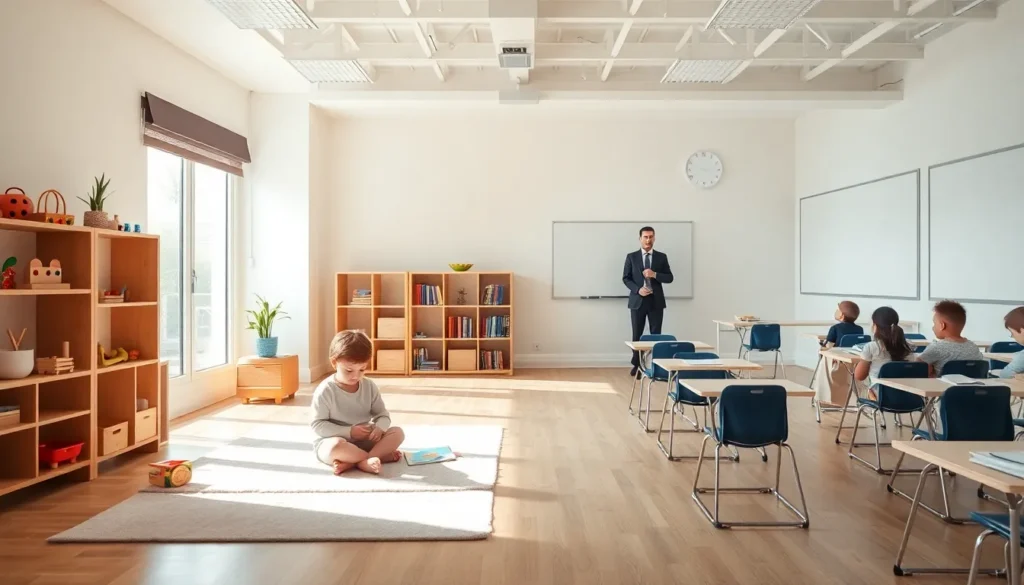
Montessori classrooms look like workshops. Low shelves hold carefully arranged materials. Children sit at tables, on rugs, or wherever they feel comfortable. The room invites exploration. There’s no teacher’s desk dominating the space.
Traditional classrooms center on the teacher. Desks face forward in rows or clusters. A whiteboard or smartboard serves as the focal point. The arrangement supports group instruction and keeps attention directed at the instructor.
Time works differently too. Montessori schedules include long, uninterrupted work periods, often three hours. Children dive deep into activities without bells breaking their concentration. Traditional schools divide days into shorter blocks, switching subjects every 30 to 50 minutes.
Curriculum delivery also separates these models. Montessori presents concepts through discovery. A child might figure out multiplication by physically grouping objects. Traditional instruction explains multiplication first, then assigns practice problems.
Assessment differs sharply. Montessori teachers observe and document progress through portfolios and narrative evaluations. Traditional schools rely on tests, quizzes, and letter grades. The Montessori vs traditional comparison here reflects different beliefs about what motivates learning.
Role of the Teacher
Teachers in each system play fundamentally different parts.
Montessori teachers act as guides. They prepare the environment, introduce materials, and step back. Their job is to observe each child and offer lessons when a student shows readiness. They rarely address the whole class at once.
Traditional teachers instruct. They plan lessons, deliver content, manage behavior, and assess understanding. The teacher is the clear authority and primary source of information.
In Montessori vs traditional settings, the relationship between student and teacher shifts. Montessori children develop independence because teachers trust them to make choices. Traditional students learn to follow directions and meet external standards.
Neither role is better, they serve different purposes. Some children need a guide who trusts their instincts. Others benefit from an instructor who provides clear direction and immediate feedback.
Which Approach Is Right for Your Child?
Choosing between Montessori vs traditional education depends on the child, not the method’s reputation.
Montessori often suits children who show curiosity, self-motivation, and comfort with open-ended choices. These kids might struggle with rigid schedules or busy work. They light up when they can explore topics deeply on their own terms.
Traditional education tends to fit children who like structure and clear expectations. Some kids feel anxious with too much freedom. They prefer knowing exactly what’s expected and receiving direct feedback on their performance.
Consider your child’s personality. Does your child start projects independently, or do they wait for instructions? Do they prefer working alone or in groups led by an adult? Answers to these questions point toward a better fit.
Practical factors matter too. Montessori schools are less common and often private, which affects cost and commute. Traditional public schools are free and usually nearby. Availability shapes choices as much as philosophy does.
Parents should visit both types of classrooms. Watch how children interact with teachers and materials. Notice what makes your child’s eyes light up. That reaction reveals more than any article can.
The Montessori vs traditional decision isn’t permanent either. Children can switch between systems. Some families start with Montessori and transition to traditional schools for middle school. Others do the opposite. Flexibility exists.