
Finding the top Montessori school for a child can feel overwhelming. With hundreds of programs claiming to follow Maria Montessori’s philosophy, parents need clear criteria to separate genuine programs from those using the name alone.
This guide breaks down what makes Montessori education distinct, how to spot quality programs, and what families should expect at each developmental stage. Whether parents are researching their first preschool or considering a switch from traditional schooling, understanding these fundamentals will make the decision easier.
Table of Contents
ToggleKey Takeaways
- Top Montessori programs feature child-led learning, mixed-age classrooms, and teachers trained through AMI or AMS accreditation.
- Look for uninterrupted work periods of 2–3 hours, which allow children to develop deep concentration and engagement.
- Since “Montessori” isn’t trademarked, verify school quality by checking accreditation and visiting classrooms during regular school hours.
- Montessori education spans from infancy through high school, with each level designed to meet specific developmental needs.
- Research shows Montessori students develop stronger academic skills, social understanding, and intrinsic motivation compared to peers in traditional programs.
- Top Montessori schools use positive discipline and encourage parent involvement to support consistent child development.
What Makes Montessori Education Unique
Montessori education centers on child-led learning. Instead of a teacher standing at the front of a classroom delivering lessons to the entire group, children choose their own activities from a prepared environment.
Dr. Maria Montessori developed this approach in Italy in the early 1900s after observing how children naturally learn through hands-on exploration. She noticed that children concentrate deeply when they work on tasks that match their developmental interests.
Top Montessori classrooms look different from traditional ones. Students of mixed ages share a space filled with specialized materials. A three-year-old might work on a puzzle while a five-year-old practices writing letters nearby. This mixed-age structure encourages peer learning and builds community.
Teachers in Montessori settings act as guides rather than lecturers. They observe each child, introduce new materials at the right moment, and step back to let learning happen. This role requires specific training, something that distinguishes authentic Montessori programs from imitations.
Key Features of Top Montessori Programs
The best Montessori programs share several consistent features. Parents should look for these elements when evaluating any school.
Prepared Environment
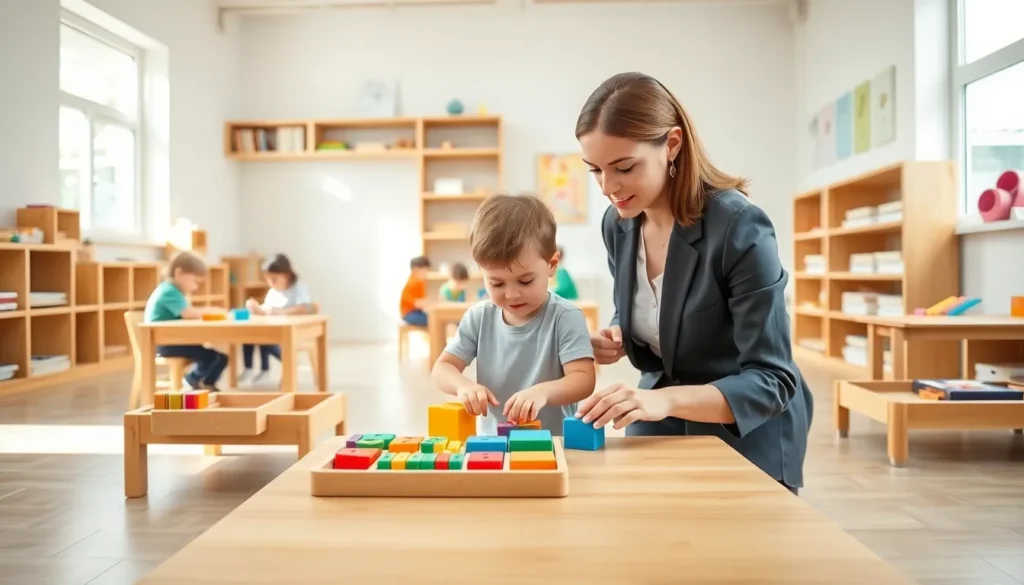
Top Montessori classrooms contain specific materials organized on low, open shelves. Children can access everything independently. Each material teaches a single concept and includes built-in error correction, so students can check their own work.
Uninterrupted Work Periods
Quality Montessori programs offer work cycles of at least two to three hours. During this time, children choose their activities without interruption. Research shows that deep concentration develops when children have time to fully engage with their work.
Trained Teachers
Top Montessori schools employ teachers with credentials from accredited training programs. Look for certifications from the Association Montessori Internationale (AMI) or the American Montessori Society (AMS). These programs require hundreds of hours of coursework and supervised practice.
Mixed-Age Classrooms
Authentic Montessori programs group children in three-year age spans. Younger children learn from older peers, while older students reinforce their knowledge by helping others. This structure mirrors natural social learning.
How to Identify a Quality Montessori School
The term “Montessori” isn’t trademarked. Any school can use the name without meeting specific standards. This reality makes parent research essential.
Start by checking accreditation. AMI and AMS both accredit schools that meet their quality standards. These organizations verify teacher credentials, classroom materials, and program structure. Accreditation doesn’t guarantee perfection, but it signals commitment to authentic practice.
Visit the classroom during a regular school day. Watch how children interact with materials and each other. In top Montessori environments, students appear focused and purposeful. They move freely but calmly. Teachers circulate and observe rather than constantly directing.
Ask specific questions during tours:
- What training do teachers hold?
- How long are work periods?
- What is the child-to-adult ratio?
- How does the school handle discipline?
Top Montessori programs use positive discipline approaches that help children develop self-regulation. They avoid reward charts, sticker systems, and punitive measures.
Parent involvement matters too. Strong Montessori schools offer parent education nights and encourage families to understand the philosophy. This partnership between home and school supports consistent development.
Age Groups and Montessori Curriculum Levels
Montessori education spans from infancy through high school. Each level addresses specific developmental needs.
Infant and Toddler (0-3 Years)
Top Montessori infant programs create safe spaces for movement and exploration. Toddler classrooms introduce practical life activities like pouring, dressing, and food preparation. These activities build coordination and independence.
Primary (3-6 Years)
This level forms the heart of most Montessori programs. Children work with materials in five curriculum areas: practical life, sensorial, language, mathematics, and cultural studies. They learn to read, write, and perform mathematical operations through concrete materials before moving to abstract concepts.
Elementary (6-12 Years)
Top Montessori elementary programs expand into “cosmic education”, an integrated curriculum connecting all subjects. Students conduct research, work on long-term projects, and often take field trips called “going out.” The classroom becomes a launchpad for investigating the world.
Adolescent (12-18 Years)
Montessori secondary programs are less common but growing. They emphasize real-world work, community contribution, and personal development. Some programs include farm work, business ventures, or intensive arts study.
Benefits of Choosing Montessori Education
Research supports many benefits of Montessori education. A 2017 study in Frontiers in Psychology found that Montessori students showed stronger academic skills, social understanding, and executive function compared to peers in traditional programs.
Top Montessori programs foster intrinsic motivation. Because children choose their work, they develop genuine interest in learning rather than performing for grades or rewards. This internal drive often persists into adulthood.
Independence grows naturally in Montessori settings. Children learn to manage their time, solve problems, and care for themselves and their environment. These practical skills serve students throughout life.
Social development also benefits. Mixed-age classrooms teach children to collaborate across developmental levels. Older students develop leadership and patience. Younger students gain mentors and role models.
Creativity flourishes when children have freedom within structure. Top Montessori programs balance clear expectations with room for individual expression. Students learn to think independently and approach problems from multiple angles.
Parents often notice that Montessori-educated children ask more questions, take initiative, and show confidence in new situations. These traits emerge from years of practice making choices and following their curiosity.